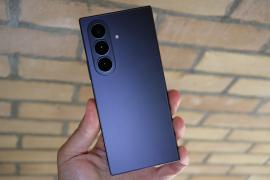
The Murena Shiftphone 8 does its best to get rid of Google, but I couldn’t live with one
Privacy-conscious software meet eco-friendly hardware

One thing all the best smartphones – or rather the ones not wearing an Apple logo – have in common? They’re all running Android, which Google uses to harvest data from billions of users on the daily. iPhones are guilty of this too – and you let them do it. License agreements filled with legalese effectively give big tech permission to build profiles based on your usage habits, so they can (among other things) target you with ads.
I’m not saying its time to break out the tin foil hat – but you do have options when it comes to de-Google-ing your life. Privacy-minded software specialist Murena has been selling versions of name-brand phones that run custom software with the Google bits largely stripped out for a while now. The latest comes from Shift, a smaller, sustainable tech firm based in Germany.
How we test smartphones
Every phone reviewed on Stuff is used as our main device throughout the testing process. We use industry standard benchmarks and tests, as well as our own years of experience, to judge general performance, battery life, display, sound and camera image quality. Manufacturers have no visibility on reviews before they appear online, and we never accept payment to feature products.
Find out more about how we test and rate products.


The €730 Shiftphone 8 arrived in a nondescript brown box, its chunky and cheap-feeling plastic bumper case pre-fitted. A glass screen protector, USB charging cable and a teensy screwdriver are also bundled in, the latter hinting at this phone’s modular, repairable nature.
Peeling off the case I was met with an all-plastic design that feels more 2015 than 2025. The rear camera unit sits almost completely flush to the back panel, which has curved sides rather than the flat ones that are all the rage right now. The “smartphones can be time killers” statement emblazoned on both the phone and the case is a bit out there, and I can’t remember the last time I reviewed a phone that used a pre-fitted screen protector with a hole cut out for the under-display fingerprint sensor.
At least it has USB-C charging, and the punch-hole selfie camera is a reminder this is indeed a current-gen handset. It also has 5G connectivity and eSIM support.
Pop off the rear case and not only get access to the battery, but a pair of tiny hardware kill switches for the microphone and cameras. You can also do this in software using the custom key on the phone’s left side. Shift says 13 different modules can be user-repaired, with each being available to buy separately on its website.


The 6.67in AMOLED screen is a highlight, being impressively vibrant and plenty bright enough for outdoor use – though a cold English November isn’t exactly a tough test. It’s nowhere near as bright as my Google Pixel 10 Pro XL, for example. Still, viewing angles are great, the 2400×1800 resolution is as sharp as I’d expect from a typical mid-range handset, and the 120Hz refresh rate keeps scrolling feeling smooth.
Elsewhere the hardware isn’t going to trouble the current flagship crowd. Power comes from an OEM Qualcomm chip on par with the five-year old Snapdragon 778G, and while it’s paired with a generous 12GB of RAM, benchmarks unsurprisingly put it near the bottom of today’s pile. I saw just 1153 and 3218 in Geekbench 6 single- and multi-core tests respectively. Apps aren’t especially eager to open and gamers aren’t going to have a great time either. 512GB of storage is generous, though, and there’s also a MicroSD card slot for adding even more space later.
The 3820mAh battery is two thirds the capacity of a modern mid-ranger like the Nothing Phone 3a – but at least the chipset isn’t a huge power hog. It’ll last a day between top-ups, unless you’re caning it with games. 18W charging is pretty pedestrian, and there’s no wireless refuelling. Of course you could always carry a spare battery instead and swap them over when you run low.
Camera quality is pretty basic, even with both rear snappers having 50MP sensors. Colour consistency between the main and ultrawide isn’t too hot, and the latter struggles with fine detail as soon as lighting conditions are anything less than perfect. The lead lens fares better, with fairly accurate hues and decent overall clarity. It was actually refreshing to see my shots display image noise, rather than be smoothed, sharpened and over-processed like a lot of current mid-range phones. The camera app feels very bodged together, though, with a clunky UI and a rather terrifying amount of low-level settings to fiddle with.


Really though, the one reason to consider this phone is its software. Murena’s /e/OS is based on Android 14, but takes out virtually every app and feature that’d see your data shared with Google’s servers. You don’t need to sign in to a Google account during the initial setup, and the App Lounge storefront sits independent from the Play Store.
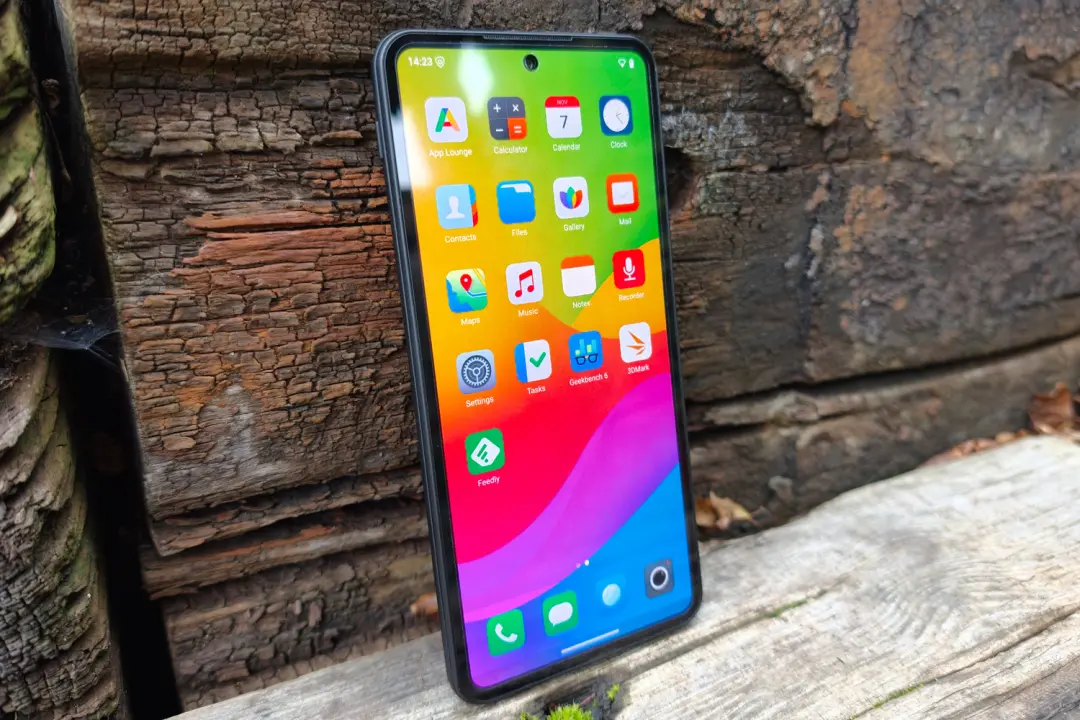
I can’t remember the last time a phone’s entire app collection could fit on a single homescreen. You get all the basics – phone, messages, calculator, calendar, clock, file manager, image gallery, music player, voice recorder – but that’s essentially it. The web browser is a bespoke fork of the privacy-minded Cromite, while the Magic Earth maps app promises it doesn’t track or trade anyone’s personal data. Most apps can feed into a Murena account if you want secure cloud backups, but they can be used entirely on-device too.
On almost every other Android phone a swipe right on the home screen would bring up Google Discover, but here you get a widget shelf that puts a bunch of advanced security toggles front-and-centre. You can fake your geolocation, hide your IP address, and block app trackers with a few taps, with a running total showing how many you’ve intercepted. It’s not like there aren’t apps on the Play Store that can do the same for a regular Android phone, but this is undeniably convenient.
The App Lounge had a lot more content than I was expecting – but that’s because it effectively has access to the full Play Store library via MicroG, a plugin that enterprising Huawei owners use to get Google services up and running now the firm is banned from including them from the factory. That means there’s nothing stopping you from registering a Google account on this device – though it does defeat the object of buying one in the first place.
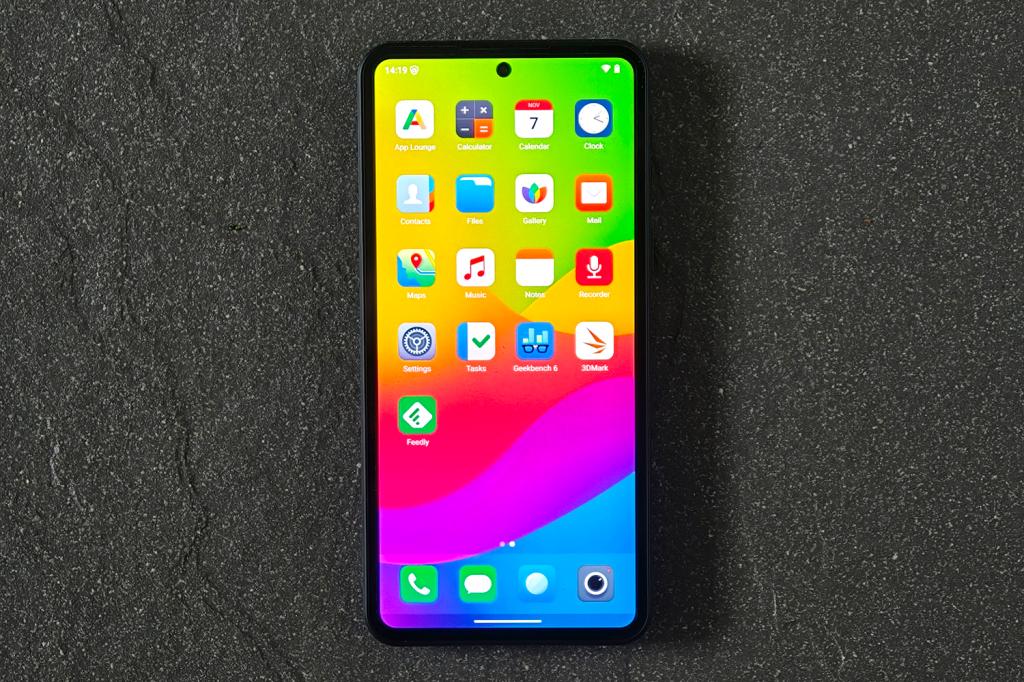
If you’d rather keep your personal data away from Google as much as possible, I get why devices like the Shiftphone 8 might appeal. Murena’s stripped-back software covers the basics, but is still willing to let you add the apps you need – unlike Huawei (which, being a Chinese firm, comes with its own baggage).
But given the Shiftphone 8 costs a significant €730 direct from Murena, you’re giving up an awful lot in hardware terms to get software peace of mind. Its spec sheet is on par with phones costing half the price, and it looks like a real throwback.
The repairability angle can’t justify that price either, at least while a Fairphone 6 costs less. The dutch rival also looks much more modern, comes with a bigger battery, and a more powerful processor – and Murena will even sell you one with /e/OS preinstalled for €649.
Stuff Says…
A bespoke OS that puts privacy first is novel and should appeal to the security-conscious, but the Shiftphone 8’s mediocre hardware hobbles its appeal.
Pros
Privacy-minded OS keeps Google at bay
Great repairability
Cons
Comparatively ancient hardware
An expensive way to keep your data off Google’s servers
Tech spec:
6.67in 2400×1080 AMOLED * Qualcomm Snapdragon 778G * 12GB RAM * 512GB on-board, microSD expansion * 50MP+50MP rear, 32MP front * IP66 * Android 14 w/ /e/OS * 3820 mAh (removable) * 164x79x9.8mm, 199g


 Tom Morgan-Freelander
Deputy Editor
Tom Morgan-Freelander
Deputy Editor