If you love colour, these super bright TCL TVs will blow you away
SQD-Mini LED tech has nuance, not just vibrancy

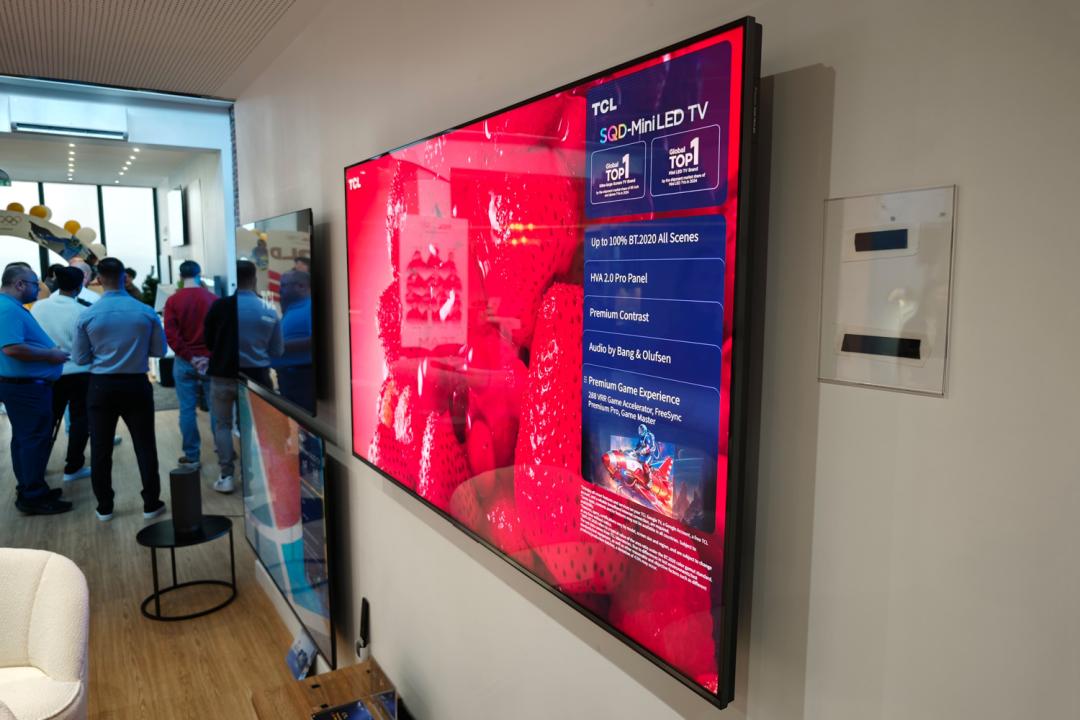
If there’s one thing TCL’s incoming lineup of 4K TVs have in spades, it’s colour. The firm’s new SQD-Mini LED panel technology has some of the most vibrant shades I’ve ever seen from a screen, yet a brief demo at TCL’s European showcase suggest there’s also refinement that could give big name rivals something to worry about.
SQD-Mini LED is a step up from the regular Mini-LED tech used last year, and multiple generations ahead of RGB-based alternative. It combines quantum dot film with a new colour filter layer that helps reduce colour dot shifting by a considerable 69%, while also expanding the colour gamut by a healthy 33%. Accuracy is still very good, though, with a Delta E 0.99. TCL reckons it’s good for 100% coverage of the BT.2020 colour space in all scenes, not just ones with a few specific hues.
Every 2026 SQD-Mini LED model will use full array local dimming and comes with a gamer-friendly 144Hz refresh rate. The flagship X11L – which has been doing the rounds at trade shows since late last year – leads the way, but this was my first chance to see the more mainstream C8L and C7L in person. They’ll be sold under different names in the US, with slightly different specs.
The C7L, which will shortly be launching in 55in, 65in, 75in, 85in and 98in screen sizes, looks to be the sweet spot of the new lineup. It’ll have 2176 dimming zones for a peak brightness rating of 3000 nits. There’s no official pricing yet, but last year the C7K launched at £899 for 55in and £1099 for 65in. That would neatly undercut the likes of Samsung and LG.


I spent most of my time in front of the C8L, which was being used to demo picture quality against a trio of unbranded rivals (which definitely weren’t a Hisense RGB mini-LED, Samsung QD-Mini LED and Sony OLED). It’s the mainstream hero, coming in 55in, 65in, 75in, 85in and 98in screen sizes. You’re getting 4032 dimming zones here, good for a peak 6000nits brightness.
With every TV set to their ‘Standard’ picture modes, TCL was keen to point out how the SQD-mini LED avoided instances of colour crosstalk – blurry sections where the individual LEDs can’t mix colour and white without losing visual clarity – or blooming when showing a mostly blue image across the whole display. The RGB mini-LED sets were way behind.
Every scene was absolutely bursting with colour – even more so than the Samsung set, which pushes the saturation more than some rivals. Colour depth and gradation were cleaner on the TCL, without crushing or instances of banded colour, which troubled the HiSense set.
This is still a full array local dimming set, so light halos and blooming are impossible to remove altogether, but I was impressed how well controlled they were. In a direct comparison with an OLED (which can turn every pixel on or off individually) the TCL set came off very well – particularly compared to the Samsung set.
I wasn’t sold on the low reflection film covering the panel; I thought it bcreated more noticeable light flares than any of the rival sets TCL. The demo footage also largely avoided fast motion and showing people, meaning I couldn’t get a feel of how it will handle skin tones and real-world footage like films or sports. What little time I had to play around with the Google TV smart interface suggests it’ll be perfectly speedy to navigate, at least.
Finally, the X11L is the flagship entry of the new range: the smallest version is 75in, with 85in and 98in models for anyone with truly cavernous living rooms. They are impressively slim for such huge sets, with an equally skinny ‘zero border’ bezel that’s either 3 or 4mm thick depending on the screen size.
The big daddy will deliver retina-searing 10000nits brightness for HDR content across 20,000 dimming zones, while all three get a new generation TSR chipset that allows for faster LED flicker (giving better light and shadow control), and speaker systems signed off by sound specialists Bang & Olufsen. It’ll also come with Dolby Atmos FlexConnect support built-in – making it the perfect pairing for TCL’s Z100 FlexConnect surround sound setup.


FlexConnect is Dolby’s attempt to standardise wireless speaker setups, letting you put satellites anywhere in a room and still get convincing spatial sound. Only a few brands have gotten on board so far, and you’ll need a compatible TV if you want it to also take your telly’s onboard speakers into account. On the X11L that includes upfiring speakers and dedicated woofers.
The Z100 has been on sale in the US for a while now, but has only recently gained an optional subwoofer.
Calibrating the four Z100 speakers and subwoofer was a one button process. Audio chimes play through each speaker in turn – Dolby supplies them, so they sounded exactly the same as on the rival LG Sound Suite – with onboard microphones calculating things like distance and sound reflections. An onscreen graphic then shows where each speaker sits relative to your sofa and the TV, with options to adjust the distance between the two.
Even in a very open demo space with lots of people wandering around, the calibration was quick and trouble-free. The resulting Atmos audio was very convincing, with objects clearly coming from above or behind.
Right now you can have four Z100 speakers and two subwoofers in a single setup, but TCL is exploring six or eight-speaker systems for 2027. In theory you could have up to 132 (the maximum number Dolby supports). That could be a very expensive purchase, though: each Z100 currently costs $230/€250 (they’re yet to be confirmed for the UK).


 Tom Morgan-Freelander
Deputy Editor
Tom Morgan-Freelander
Deputy Editor