Sony InZone KBD-75 review: a tank of a tiny keyboard that doesn’t make the most of its magnetic switches
Analogue inputs meet minimalist styling

Stuff Verdict
The InZone KBD-75 does almost everything you’d want a high-end gaming keyboad to., but you’ll pay a pretty penny for one, and it’s wired connectivity only.
Pros
- Accurate, adjustable switches in a desk-friendly form factor
- Minimal multimedia shortcuts are welcome
- Rapid 8000Hz polling and instant response
Cons
- No wireless version
- Wildly expensive
- Software pretty pared back
Introduction
Sony’s PlayStation division might know more than a thing or two about console gaming, but the fledgling InZone team had zero experience with gamer-grade keyboards before unleashing the KBD-75. Tapping up esports giant Fnatic to help mould it from the off was a smart move: the result reads like a laundry list of everything a modern PC player could want. Well, almost.
Hall effect magnetic key switches with adjustable actuation are the crucial one, but a speedy 8000Hz polling rate and a travel-friendly size also rank highly. Per-key RGB backlighting and a minimal metal chassis tick a few more boxes. The one downside?Connection is strictly by cable only.
At $298/£250, the KBD-75 is priced to compete with analogue rivals that have managed to ditch the cable. It’ll set you back double that of boutique boardmaker Keychron’s K2 HE, and it’s not like Sony has gone overboard on features elsewhere. Can only the hardest of hardcore gamers justify such an outlay?
How we test keyboards
Every keyboard reviewed on Stuff is put through its paces for both typing and PC gaming. We use our years of testing experience to judge build quality, software experience, lighting effects and other features. Manufacturers have no visibility on reviews before they appear online, and we never accept payment to feature products.
Find out more about how we test and rate products.
Design & build: little black brick


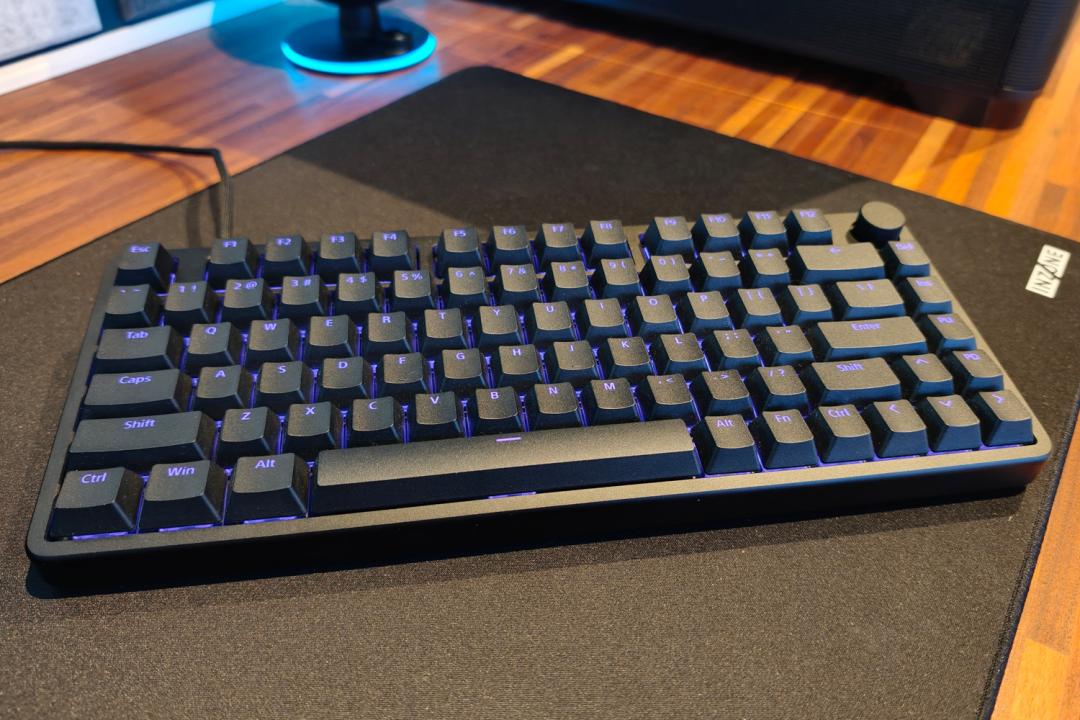
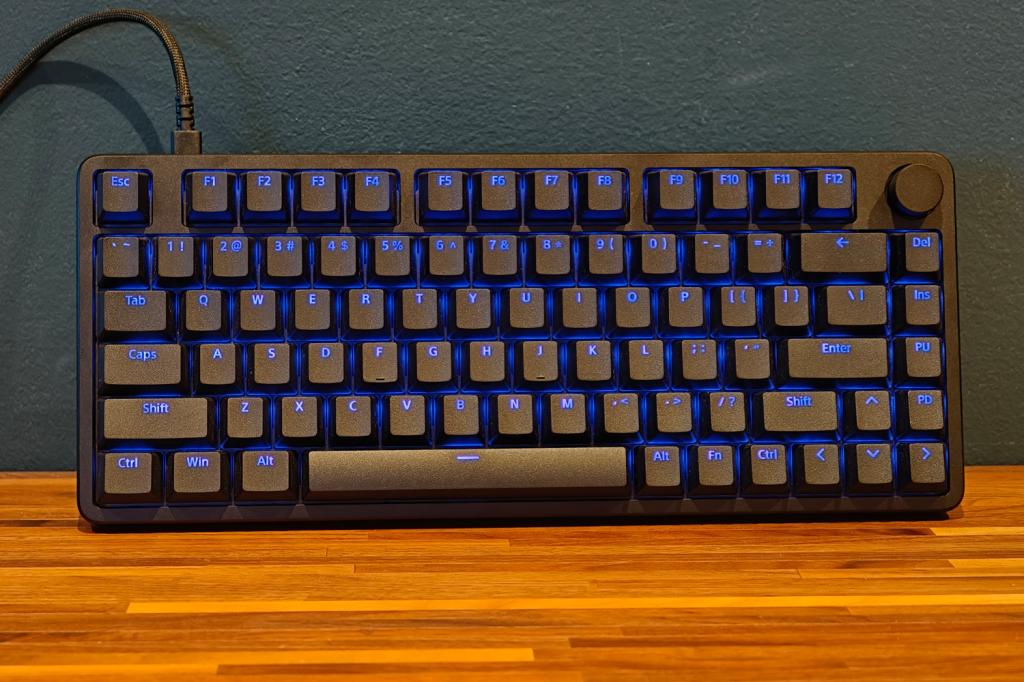
The InZone KBD-75 gets right to the point, with just a single size and one kind of key switch on offer. It’s only available with a US layout, single-height enter key included, and only comes in black. The 75% size ditches a numerical keypad and shifts the arrow and navigation keys, but it doesn’t mess with the punctuation keys like smaller 65% or 60% boards do.
An especially skinny frame helps make this even smaller than the average 75% keyboard, meaning it took up very little space on my desk. The top plate is a fingerprint-resistant metal that’s cool to the touch, and feels every bit as high-end as you’d hope given the asking price. It almost entirely obscures the plastic lower half, too. At 810g it feels suitably dense, but nowhere near as much of a heavyweight as the all-metal Glorious GMMK 3.
The flip-out feet and single strip of rubber keeping the keyboard securely in place are the only things of note on the underside. You only get one additional height option here, rather than the two you’ll find on other boards, but it’s shallow enough I didn’t feel the need to add a wrist rest.
I’ve not spotted any signs of wear from the key caps, which are made using the industry standard Doubleshot PBT plastic. They’ve got a similar feel to every other gaming keyboard’s stock caps, with a largely smooth surface that’s just mottled enough for useful grip. I like that there’s zero key wobble or rattle, and that Sony has sensibly gone with cross-style switches underneath. Pretty much every gaming keyboard uses these, meaning third-party alternatives are in steady supply if you want to change up the all-black appearance.
Features & software: back to basics


Being a wired keyboard, the only pack-in is the 1.8m braided USB Type-C to Type-A cable.
You don’t get any extra function keys or shortcuts here, just a small volume knob in the top right corner that can mute your PC with a press. It can’t be configured to do anything else. You don’t even get symbols etched into the function keys, so any shortcuts you do set though the software have to be committed to memory.
The per-key RGB lighting delivers even illumination across the board, with only a little bit of light leakage between the keys. The way it lights up from the centre of the board outwards to match the InZone logo is a nice touch, and defaulting to brand-accurate purple is a refreshing change from the rainbow seizure hazards seen on other keyboards.
You can get pretty granular with the lighting customisation through Sony’s InZone Hub software, though there’s no way to download any community-made setups if you’re not a fan of the 10+ presets. The app also lets you create macro key combos, and being able to independently disable the Windows key, Alt+Tab, and Alt+F4 shortcuts is a neat alternative to a generic Game mode. I know I like to bounce between games and a web browser when stuck on single player games.
The analogue switch adjustments have a bigger impact on multiplayer titles. You can set actuation levels – the exact point at which a keypress is registered – down to the tenth of a millimetre, for every key. Rapid Trigger then gives you control over the release point, for otherwise impossibly fast inputs.
Performance: input excellence


Typing on the KBD-75 was a breeze, with the gasket-mounted inner circuit board feeling incredibly firm under my fingers and the keys having just the right amount of bounce. They produce more of a clack sound when bottoming out, but with a lighter touch I rather liked their quiet yet “thocky” noise. Multiple layers of sound-dampening material inside the board help it avoid irritating anyone you have to share a gaming space with.
Latency is as low as it gets, thanks to the 8000Hz polling rate ensuring your inputs are read every 125ms. I had no issues with dropped or ghost inputs, even with multiple keys pressed simultaneously.
Actuation defaults to 1.5mm, but you can fine-tune every key anywhere between 0.1mm and 3.4mm. That’s a useful amount more than the low-profile Logitech G515 Rapid TKL, but not quite as much as the Steelseries Apex Pro Gen 3. I felt it made a difference in hectic FPS games, partly making up for my mid-30s reaction times when having to quickly back out of rooms already occupied by enemies in Battlefield 6.
It’s odd that there’s no kind of simultaneous opposite cardinal direction (SOCD) support. These enable quick peeking in and out of cover in first person shooters, and are found on practically every other keyboard with magnetic switches. Maybe Sony didn’t want to risk it, given some games now flag this as cheating.
No dynamic keystroke system feels like a bigger omission; it means you can’t set one key to walk when half-pressed but run when pressed in fully. Given these are two of the biggest reasons to buy a magnetic keyboard, hopefully Sony can add them in through software later down the line.
Sony InZone KBD-75 verdict
Functionally, the KBD-75 is a top performer. The magnetic switches are precise and almost infinitely tweakable, while the build quality is superb. I’m a big fan of the compact size and subtle styling, too. Personally I’m too obsessed with cable cutting and a clean desk to go back to a wired keyboard, but competitive gamers wanting an edge will love the rapid polling rate and instant inputs.
Whether many of ’em will be able to justify the high price is up for debate, though. Rivals both wired and wireless cost less, and also add things like SOCD inputs into the mix.
Stuff Says…
Sony has cleared the bar at the first time of asking: the InZone KBD-75 does almost everything you’d want a high-end gaming keyboad to. You’ll pay a pretty penny for one, though, and it’s wired connectivity only.
Pros
Accurate, adjustable switches in a desk-friendly form factor
Minimal multimedia shortcuts are welcome
Rapid 8000Hz polling and instant response
Cons
No wireless version
Wildly expensive
Software pretty pared back
Sony InZone KBD-75 technical specifications
| Keyboard style | 75% Tenkeyless (TKL) |
| Switch type | Magnetic/Hall effect |
| Connectivity | USB-C |
| Dimensions | 319xx132x37.5mm, 810g |


 Tom Morgan-Freelander
Deputy Editor
Tom Morgan-Freelander
Deputy Editor