The evolution of motion control
Join us as we take a stroll through motion control’s 20-year history, from Sega VR to Leap Motion

Motion control has come a heck of a long way since the days of clumsy virtual reality headsets. In fact, we seem to be edging ever closer to that scene in Minority Report where Tom Cruise flicks a load of stuff around on a screen – except unlike Tom we probably won’t even need to wear a pair of special gloves. Join us as we look at how motion control has developed over the past 20 years.

Riding high on the success of the Mega Drive, Sega developed this add-on – which rocked twin LCD screens for stereoscopic visuals as well as inertial motion detectors – in an attempt to jump aboard the virtual reality bandwagon of the early 90s. Sadly, the wheels fell of that bandwagon and it rolled into a ditch. And then exploded.
When Sega revealed a prototype of the device in 1993, it was panned by the press among fears that it would cause motion sickness and headaches. And thus the Sega VR quietly disappeared before launch, with its makers claiming it was simply “too realistic” for the public. Whatever you say, Sega.
Sega VR (1993)

As entertainment-focussed Windows Media Center PCs started to enter the living rooms of early adopters, it became increasingly clear that Microsoft’s own traditional remote control wasn’t going to cut it: while it was fine for basic media control, it became about as useful as a marzipan hammer when you dipped back into Windows proper.
One excellent response was the Gyration mouse, which could be wielded much like a magic wand. A non-Bluetooth radio link let it communicate wirelessly with your PC, while two gyroscopes detected its 3D motion and translated that into pointer movement on your desktop. Good stuff.

The Wii Remote brought motion control to the masses, with an accelerometer measuring movement along three axes and an optical sensor detecting the way in which it was pointing. While neither of these were new technologies, Nintendo used them in a way that nobody to date had: suddenly, people who’d shriek and leave the room at the sight of a “traditional” game pad were merrily bowling, boxing and driving karts around tracks.
In 2009, Nintendo introduced the MotionPlus add-on for the controller, which boosted its movement detection accuracy by adding a gyroscope.
Gyration Media Center Remote (2002)

The launch controller for the PlayStation 3, the Sixaxis resembled a PS2 controller but was wireless and rocked an accelerometer able to track motion across (yep, you guessed it) six axes. This meant it could be used to steer during a racing game or keep Nathan Drake balanced as he walked across a log.
However, gamers didn’t really take to the Sixaxis: it lacked the rumble feedback of the PS2 DualShock controller (due to legal issues), which led to a deluge of criticism – and many felt that the motion controls were poorly developed and gimmicky. In 2008, Sony replaced it with the DualShock 3 which (huzzah!) combined motion-sensing with rumble. Much better.

Apple’s first generation iPhone was among the first mobiles to feature an accelerometer, most frequently used to auto-rotate the screen when you flipped the phone between portrait and landscape modes. It also made a handy games controller for certain titles, as you could tilt the phone to steer.
Since then, accelerometers and gyroscopes have become as vital a part of smartphone design and usability as touchscreens and GPS – for instance the Samsung Galaxy S II and its tilt-to-zoom function.
Nintendo Wii Remote (2006)

Sony introduced its own take on “proper” motion control with the wand-like PS Move, able to accurately track the user’s position (in conjunction with the PlayStation Eye camera) and its own movement through an accelerometer, a rate sensor and a magnetometer – the latter of which detects the Earth’s magnetic field.

Like Sony, Microsoft attempted to emulate the Wii’s success with motion control through its own technology – but it did away with a physical controller completely. Kinect uses a sophisticated (but affordable) camera to track the body movement of the player in three dimensions, so in essence your body becomes the controller. 48 skeletal points can be monitored in total, allowing for a surprising degree of accuracy. The only downside? You need a fair old bit of space to swing your arms and legs around.
Sony PlayStation Sixaxis (2006)

Due for launch later this year, Leap Motion’s “Leap” device takes a similar approach to Kinect, but rather than track your entire body it concentrates on your hands and fingers by using a USB peripheral to record their motion in a small space above your desktop.
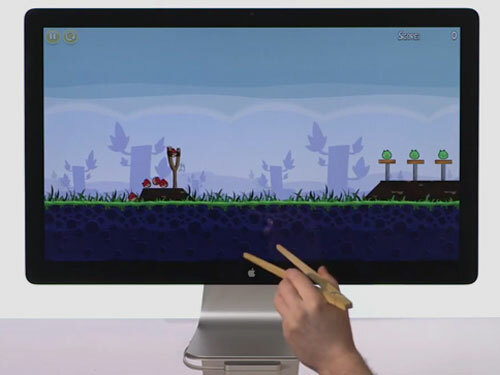
You can perform gestures like pinch-to-zoom, manipulate complex 3D models using one or both hands, draw accurately with your finger and even play FPS games (holding an imaginary gun and pulling your trigger finger to shoot). You can even use simple tools like chopsticks – and use them to play Angry Birds. It’s the closest to a Minority Report-style controller we’ve seen, and we’re mightily impressed with its potential – not to mention its low price tag of US$70 (£45).
Stuff Cool List 2012 issue is out now!
BBC launches updated live video player in preparation for Olympics
Best iPhone apps this week

Apple iPhone (2007)


Sony PlayStation Move (2010)


Microsoft Kinect (2010)


Leap Motion (2012)



 Dan Grabham
Editor-in-Chief
Dan Grabham
Editor-in-Chief